Apr 13, 2009

A Big Step Foward in the Health IT Race

The spread of new ideas and technology are interesting phenomena to observe and study. In the social networking world, Friendster led to Facebook and MySpace and where does Twitter fit in? When it comes to adopting new technology, those under the age of 25 tend to adopt things faster than those over the age of 65. Or to put it this way, it's not uncommon for me to see a group of middle school students jamming to their iPods while texting on their cell phones. But, watching a video of my 94 year-old grandmother playing Wii Bowling rocked my world!


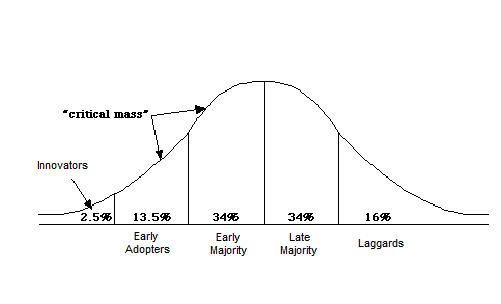
In a book titled Diffusion of Innovations written by Everett Rogers, Rogers outlines a model for the adoption and diffusion of innovation. When it comes to adopting new technology, health care is notoriously known to be part of the "late majority" or "laggard" groups. Some argue that the use of internet computing for communication in health care has not changed in decades!

Well, that is all hopefully beginning to change. The recently enacted stimulus bill — the American Recovery and Reinvestment Act of 2009 (ARRA) has allocated $19 billion to promote the adoption and use of health information technology (HIT), with a focus on electronic health records (EHRs). In a Perspectives piece published in the New England Journal of Medicine on April 9th, Dr. David Blumenthal, the newly appointed National Coordinator for Health Information Technology, discusses the challenges and goals of stimulating the adoption of HIT.

As discussed in the piece, currently, only 17% of US doctors and only 10% of US hospitals are using even the most basic form of EHR. Because of the substantial upfront cost, the perceived lack of financial return from investing in HIT, the technical and logistical challenges involved in installing, maintaining, and updating them, and consumers' and physicians' concerns about the privacy and security of electronic health information, the medical field has decided not to jump on the technology bandwagon. While Washington DC does have a plan to incentivize physicians and health systems to adopt EHR through Medicare and Medicaid benefits, much work needs to be done. Substantial investments need to be made to create an interoperable system that is flexible to new technology updates, yet provides security and privacy. President Obama has promised that by 2014 every American will benefit from having a personal EHR. Just like the IHI WHO Surgical Safety Checklist Sprint, laying down the foundations of this HIT system will be a race--not quite a marathon in duration. Let's call it the 10K HIT race.

Since the HIT race started with announcement of the ARRA, President Obama and several partnerships have provided several refreshing swigs of water. Last Thursday, President Obana, along with Department of Defense (DoD) Secretary Robert Gates and Veterans Administration (VA) Secretary Eric Shinsheki, announced the commitment to create a Joint Virtual Lifetime Electronic Record, a system to computerize medical records for all military personnel. This Joint Virtual Lifetime Electronic Record would effectively bridge the records the DoD holds on active-duty men and women and the records the VA holds on veterans. With the military leading the way as it has done on several occasions in the past, President Obama is sending the message that an investment in HIT is not just to bring technology to health care, but to improve the quality of health care delivery, the health of populations, and the efficiency of our health systems. President Obama hopes that the military system will become a model for the rest of the nation to adopt. Click here to read the release.

Side note: Dr. Don Berwick was asked to appear on NewsHour with Jim Lehrer to discuss this new announcement of a streamlined military EHR and its implications on health care. See the video below!


Having trouble viewing? Click here to watch a streaming video clip, read the transcript, or download the audio clip.

Other spurts of refreshing water have come from partnerships. GE Healthcare announced a partnership with both the CDC and Johns Hopkins to create an easy way to report and target alerts on epidemics. Click here to read Business Week's coverage. Mayo Clinic has partnered with IBM to create a website to consolidate the tools used to search records and data of all kinds. Click here to read The New York Times' report on the new project called, the Open Health Natural Language Processing Consortium.

What other sorts of sprints or 10K races has the government or military led in the past? What features of an EHR are most important to you? How do you think EHRs will transform health care delivery?

Apr 11, 2009

"Mistaken Identity"

Here's a great poem from Pulse Magazine.

"Mistaken Identity"
by Kathleen Grieger

Surgery finished,
I finally sleep

Pushing my shoulders,
the technician wakes me

"Come now,
we need a chest x-ray"

Smiling, she pulls me
into position

The x-ray machine
tight against me

Finally getting a chance,
I ask what she is doing

"Oh," she says "I have
the wrong one

You are not a 64
year old male"

Lying me down,
she walks away

As I fall back to sleep,
I wonder, now bald

what I must
look like

About the poem: "Frustrated with the problems and errors that were hugely complicating my medical treatment after brain surgery, I realized that it was necessary for me to start writing again. Because I'd been so busy before, my poetry had been set aside; picking it up again was the best thing I've ever done."

Questions/Comment:

1. As a health care provider, do you use a creative outlet to express your stress or frustration with work? What do you do?

2. What steps are you taught to make sure you have the right patient? Does anyone teach you this? Or, what steps does your health care organization take to make sure you operate on the correct patient?

3. Have you ever had an experience like the patient in the poem?

Introduction to Myself!

Hi, everyone! I was very excited to be invited to write for this blog. As a soon-to-be intern, I enjoy the opportunity to document my experiences both in the field of family medicine and quality improvement. My hope is to use this blog to not only document what I am seeing and doing, but also to use it as an opportunity to reflect upon and discuss issues related to the larger issues of healthcare quality and patient safety. I am also excited to depict how these issues will flavor my experiences as a resident. Lastly, I agreed to write for this blog because that act of writing, itself, relaxes me.

Before I get into any discussion of my experiences in QI or as Aultman Hospital’s Open School President, I feel that I should tell you more about myself. I would like to do this, because the descriptions of my experiences may be skewed by my beliefs, experiences, etc. How am I different than you? How am I the same as you? I would like you to know these things and analyze my writings in light of this information.

I am an only-child. Both of my parents are from the Philippines. Neither of my them are physicians. My mother is a nurse, and my father is a retired engineer. He has diabetes and has had multiple complications related to the disease. I am Catholic. I was born and raised in Cleveland, Ohio. I have attended a private Catholic grade school, and a private Jesuit high school. I did my undergraduate learning at St. Louis University. I briefly considered training to get a Ph. D. in psychology during college. Therefore, I did one year of research at Washington University of St. Louis in the hopes that such an experience would help me make up my mind. I decided that bench research took me too far away from the sort of ‘helping’ that I had always envisioned myself doing. So, I took the MCAT and came back to Ohio to attend medical school. There, I found my passion and niche in primary care.

My interest in QI and PS stems from multiple experiences in the realm of medicine. I remember how frustrated I felt when I learned (on more than one occasion) of the mistakes that hospital staff made while my father was under their care. I remember my mother’s stories of her being witness to less than optimal quality care by some of the hospital staff. As a medical student, the gap that lies between what one learns in the classroom and what one actually experiences on the wards is, at first, shocking.

I knew that I wanted to make a difference in this aspect of medicine.

Today, I am currently the Founder/President of the IHI Open School at Aultman Hospital, which is a community hospital in Canton, Ohio. I am a 4th year medical student at the Northeastern Ohio Universities College of Medicine in Rootstown, Ohio. I will be doing my residency in family medicine at the Mayo Clinic in Jacksonville, FL.

My current favorite band is Coldplay. I relax by going to the gym, writing, and cooking. I am a fan of the Cleveland Cavaliers.

So, that’s me. My next post will be about the starting of a hospital-based Open School Chapter – what worked, what did not. If you have anything else that you would like to know or any topics that you would like me to cover in this blog now or in the future, please let me know.

Again, I am excited to be able to share my experiences and thoughts with you all!

Apr 9, 2009

Timeout? No thanks. With stakes this high, I’d rather keep working.

As a medical student who is both only weeks away from graduation (Duke, please don’t withhold my diploma) and a long-time admirer of Dr. Groopman’s work, it is with some trepidation that I respond to the recent opinion piece in the Wall Street Journal “Why ‘Quality’ Care Is Dangerous” by Jerome Groopman and Pamela Hartzband.

However, the issue of healthcare quality improvement is too important for me to ignore such a potentially damaging editorial. Strangely, the article reminded me of a variety of clichés often used to argue against well-intentioned words of caution (such as those of Groopman and Hartzband) including, “Don’t throw the baby out with the bathwater;” “Don’t let the perfect be the enemy of the good,” and “Rome wasn’t built in a day.”

These clichés aren’t excuses. Progress has got to start somewhere, and while we have a long way to go, patients are far better off today than they were in November of 1999 thanks to the myriad efforts of so many dedicated quality improvement champions. Unfortunately, Groopman and Hartzband give only a brief nod to this progress.

By largely ignoring the successes and claiming that early missteps in particular quality efforts (namely public reporting and pay-for-performance) are examples of the system gone awry, the authors are doing patients and medical progress a serious disservice. They call for a “time out” in the progression of our healthcare system towards increased accountability and improved quality. (And let’s ignore for a moment the potential harm caused by the title of the article which implies that the entire spectrum of quality improvement efforts is dangerous).

Are there problems? Yes. Are there inherent risks in any major changes to a system as complex as the U.S. healthcare system? Of course. In fact, the article articulates many of the risks and, to date, failures of some of these efforts (which I hope to discuss in more detail in a follow-up posting). However, those of us who are patients, have friends or family who are patients, take care of patients, or simply pay taxes, should not accept the “time out” called for by Groopman and Hartzband; especially since I don’t remember seeing any breaks or timeouts in continuous quality improvement cycles.

- Duke University Medical Student, c/o 2009

The End of an Era...


Last Thursday, the last episode of NBC's ER was aired, capping a 15 season run on television. I wouldn't call myself an avid fan of the show since I have not watched every episode and nearly forgot that the show existed until hearing about the WHO Surgical Safety Checklist being featured in an episode! Click here to read the post.

As I watched the last episode, I couldn't help but feel a twinge of sadness. The final episode was filmed in a way that mirrored the pilot episode, spanning across the work and lives of the ER staff across a few days. A unique storyline that I related to the most was the one of Dr. Mark Greene's daughter returning to the ER at Chicago County General, but this time, as a prospective medical student. We are all and will be patients one day, but the first time you walk into a hospital with the gumption that this is where you will work one day or this is an area you will be studying--it's magical. I completely understood the wonderment and bewilderment in her eyes as she walked around the ER.

How do medical TV shows affect us? Experience and age have taught me that TV is not the best representation of reality. But, as a kid growing up with immigrant parents, TV was an important portal to learning what living the American life meant. Once I outgrew Sesame Street, certain television shows like Full House, Family Matters, Step by Step, Saved by the Bell, and MacGyver were okay-ed by my parents. Then, I graduated into watching TV with my parents. My parents even marketed shows like Dr. Quinn Medicine Woman as a show that could teach me good American history and learn what being a doctor is like.

I can confidently say that the main reasons why I want to enter the medical field are not rooted in television, but I don't think I can say with equal confidence that watching these medical shows has not influenced my perception of the occupation and field. I can't count the number of times I've said, like any impressionable child, "That's so cool! I want to be just like him/her!"

Studies have shown that television shows don't just affect children, but influence the perceptions of watchers of all ages. According to the New York Times article, "ER"--A Made-Up Hospital that Offered Real Medicine, two years after the first episode of ER aired, a study in the New England Journal of Medicine reported that ER and other shows illustrated an unrealistic and overly positive picture of cardiopulmonary resuscitation(CPR). How did ER respond? In a later episode, Dr. John Carter breaks an elderly man's ribs while performing CPR.

This sort of feedback between the medical field and television has resulted in the medical field seeing television as a vehicle to reach millions of people and making television a health information resource. Health literacy is extremely important, so why not use something people already enjoy and inject a couple of good messages here and there?

So, how did the WHO Surgical Safety Checklist pop onto a show like ER? Firms such as Hollywood, Health, and Society help health organizations and agencies connect with Hollywood writers and help craft their messages in ways that can readily be used on screen. Dr. Atul Gawande met with the ER writers to highlight the surgical checklist and the rest is well....recorded in history. Click here to watch the episode.

While I admit that a lot of what is portrayed on medical dramas is ridiculous and soap opera-like (interns sleeping with attendings, people dropping like flies because of flesh eating bacteria infections, etc.), there is some value in watching medical dramas. Health care and medicine are not just about the science of diseases and treatments, but is also about the narratives of patients, families, and health care providers. I can't think of a better medium than the television screen to share these narratives with millions of people at a time. It certainly doesn't hurt to have a gorgeous Hollywood actor like George Clooney tell the world about how important colonoscopies are after the age of 50!

If you had the opportunity to approach Hollywood writers, what kinds of issues would you pitch to be dramatized?

***This past Tuesday and next Tuesday PBS broadcasts “Nova” airs “Doctors’ Diaries,” the most recent installment of a 22-year chronicle about seven former Harvard medical school students. Check it out for real life medical TV! Click here for more information!***

Apr 7, 2009

World Health Day 2009


World Health Day is a global initiative led by the World Health Organization (WHO) and this year, World Health Day focuses on the safety of health facilities and the readiness of emergency workers in the face of disaster and emergencies. That's a WOOT for safety getting international recognition!

With sudden natural disasters such as the recent earthquake in Italy and the great tragedies of Hurricane Katrina, the earthquakes in Sichuan, and the tsunami that hit Southeast Asia all in recent memory, it is essential that health care facilities are both prepared to handle these crises and can handle things safely.

On the WHO World Health Day page, it says:

"This year, WHO and international partners are underscoring the importance of investing in health infrastructure that can withstand hazards and serve people in immediate need. They are also urging health facilities to implement systems to respond to internal emergencies, such as fires, and ensure the continuity of care."

While World Health Day 2009 focuses specifically on ensuring safety in an emergency context and ensuring health care facilities are prepared in light of emergencies, what kinds of patient safety and quality improvement interventions should be considered when designing safe and rapid response systems?

To read more about World Health Day 2009 background and activities, click here!

Also, take an IHI Open School Patient Safety Course to learn more about patient safety in hospital systems. Click here to start! What elements of the course are most important in an emergency setting?

Apr 6, 2009

It's a bird....it's a plane....it's....

NOT Superman, but PUBLIC HEALTH to the rescue!

What is public health? Public health has an amorphously large definition. I admittedly used to think that public health was the field filled with people who wanted to go into medicine and help people, but couldn't stand basic science and the gore of cutting up bodies, plus the environmentalists, ethicists, and epidemiologists. For a while, the definition that public health was population based medicine, while medicine in the conventional sense was individual based seem to work. But, that doesn't quite cover all of the bases of public health either.

Dr. Howard Koh, President Obama's nominee for Assistant Secretary for Health in the Department of Health and Human Services (HHS), has a wonderful and all encapsulating definition of public health that goes kind of like this (I apologize that this is not an exact quote!), "When you wake-up in the morning and take in a breath of clean air, that's public health. When you brush your teeth and the water coming out of the faucet is fluoridated, that's public health. When you eat breakfast and you pass up the donuts for a healthier alternative, that's public health. When you drive to work and you put on your seatbelt, that's public health. Better yet, you ride your bike to work, that's public health. When you get into an accident and an ambulance arrives and takes you to the nearest hospital in a timely manner, that's public health. When you receive great care at the hospital, that's public health....."

The scenarios continue till you realize that public health is something that is absolutely necessary and works hard in the background of our everyday lives. It's only missed when public health doesn't work.


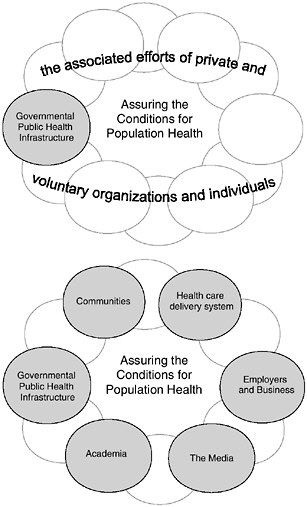
The WHO definition of public health (since 1946) is: "a state of complete physical, mental, and social well-being." It's hard to narrow down or make the definition of public health more specific because public health is inherently multi-disciplinary. It includes various different fields including: government, communities, the health care delivery system, the media, academia, employers and business, and at the center of the diagram should be the individual. Because public health is everywhere and touches so many life sectors, shouldn't it make sense that everyone and anyone be involved in public health? Instead of babbling on and attempt to define public health, watch this video made by Generation Public Health in honor of the American Public Health Association's National Public Health Week!


Thanks Ninon!


Some other inspiring infographic videos that may be of interest to you that touch on related topics are:


The Girl Effect


Did You Know?